Showing posts with label Photos. Show all posts

Saturday, April 10, 2010

Photo: Quick Look into History


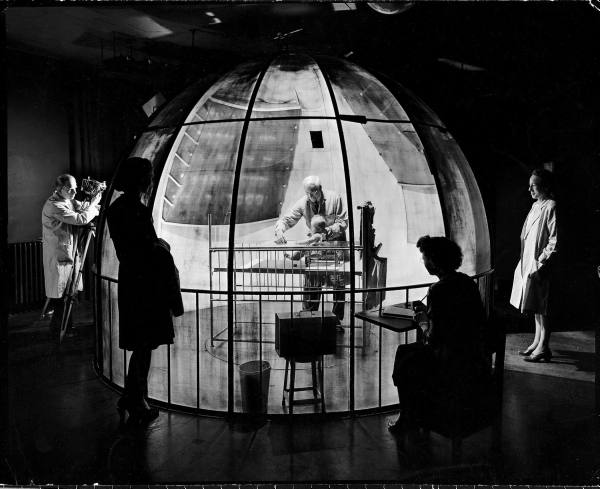
Dr. Arnold Gesell was a psychologists at Yale University and focused on child psychology. The picture was taken in 1947 as one of the child psychology labs at Yale. He used video cameras and photographic cameras to aid him in his research. The photo shows Dr. Gesell observing a child in a "one-way mirror shaped as a dome." The purpose of such a dome was so that the children inside the domes could be observed without any disruption from people and the environment outside of the dome. This was a useful piece of technology because it didn't include any outside variables that may affect the observation at hand. Although the picture was taken many years ago in which the quality of photographs were not at its highest, I think this photo was taken very well. The focus of the picture is clearly Dr. Gesell and the child inside the brightly-lit dome. It also follows the rule of thirds and has a clear focus. Although some parts of the photo may be too exposed, it could also be the fact that cameras back in the day were not as advanced as they are now, or the lighting may have been an issue. Either way, I think this photo is a good example of capturing history in the making.

More Psychological Pictures Continued

Continuing my blog with pictures relating to psychological technology, here are two more pictures representing this topic. The first picture is known as "biometric recognition." According to the blog titled, "Family Stop Here," biometric recognition is a technique used to identify people by their psychological and behavioral traits. In this situation, psychological traits do not necessarily mean how a person thinks or feels. Physical characteristics are what make up the psychological traits, such as shape of the body, scent, size, etc. Behavioral traits include characteristics such as voice recognition. Biometric recognition is quickly becoming a hot new addition to the technology world, especially in places needing high security. In other words, the government is highly interested in this technology.
The photo has obviously been edited and computerized. The way it was finalized was to show how scanning a person's hand using biometric recognition might look like. With the way it looks, I would say the person who edited the photo was successful in making it look like it is actually being scanned.

The second picture shows a woman wearing what looks like an oversized helmet with a bunch of wires and cameras attached. In fact, the helmet is the headgear that most pilots in the military wear when flying helicopters such as the Black Hawk. According to the article, "Research Lab Combines Psychology with Technology," graduate student, Sage Jessee, has worked as the "eye-tracking specialist on a video game style simulator that monitored the pilot’s point of gaze and head position during flight scenario." The focus of this new technology is to help pilots view the landscape and other things in front of them by looking out the windows, rather than looking at the panel inside of their cockpit. This allows more visual communication and more accuracy. This can also lead to potential benefits such as "reducing pilot errors and saving lives." I think this is a good photo. The photographer followed the rule of thirds, and captured the people in action. Its showing the beginning of structuring a new piece of technology.

Sunday, April 4, 2010

Picture This, Part II

Okay, so I will be honest. I had some difficulty taking pictures that dealt with both technology and psychology. However, I was able to take some pictures over the weekend and edit them through Picasa. With all of the pictures, I tried to incorporate the rule of thirds, and to capture the essence of the image. Most of these pictures show my friends or relatives interacting with the technology around them. The first picture is basically the only picture that I can say can relate to psychology. I captured my friend becoming frustrated with his computer and his homework at the same time. Coincidently, his homework was to create a computer program.
The next photo is a friend of mine listening to his ipod on one of the nicest days last week. Unfortunately, I didn't realize at the time that the sun would be an issue. I tried taking the photo at the opposite angle, but my shadow was in the way. Basically this means I need more practice being a photographer.
The next photo shows my cousin's 2-year-old daughter. She is quite the curious one, and as you can tell by the picture, she was curious about the TV. This picture would be nice if it weren't for the glare on the TV, but it was still an okay picture.
The last picture really has nothing to do with technology or psychology whatsoever. But I thought it was a really cute picture. We told her to "pose" and this is what she did. Just a fun picture I wanted to add...


Saturday, April 3, 2010

Picture This, Part I


As I desperately searched throughout the internet for pictures relating to both psychology and technology, these were some that I found to be interesting, both in appearance and information.
The photo on the right is a picture of an MRI machine. While some may argue that the lighting is too colorful with the reds, pinks, yellows, etc., I think it makes it look more interesting. Most of the pictures I saw of MRI machines were boring, dull, and similar. In fact, this picture makes it look less scary to those who are wary of such machines.

According to Medline Plus, MRI stands for magnetic resonance imaging and takes pictures of the brain using magnets and radio waves. Some doctors recommend their patients to get an MRI scan of their brains in order to determine any issues regarding the brain such as tumors, abnormal development, bleeding, etc. In some psychological situations, an MRI can be useful in determining causes of disorders.

The photo on the left captured my interest because instead of focusing on the person, it focuses on the screen. The camera clearly focuses on the screen by making the person on the left blurry. At the same time, it shows the difference between the reality (the person's hand on the desk) versus the virtual reality on the computer screen so that you can see what the picture is about.

The article, "Augmented virtual reality treats phobias," reports of a new technology system that claims to be a treatment for phobias (such as arachnophobia). The virtual reality treatment allows the patient to interact with their fears, without actually interacting it in real life. Despite the fact that the virtual reality is unreal, it still triggers the anxiety and fear in the patients. If they are able to face their fears through this treatment, it will make it easier for them to deal with their fears in real life.